Sherman's March
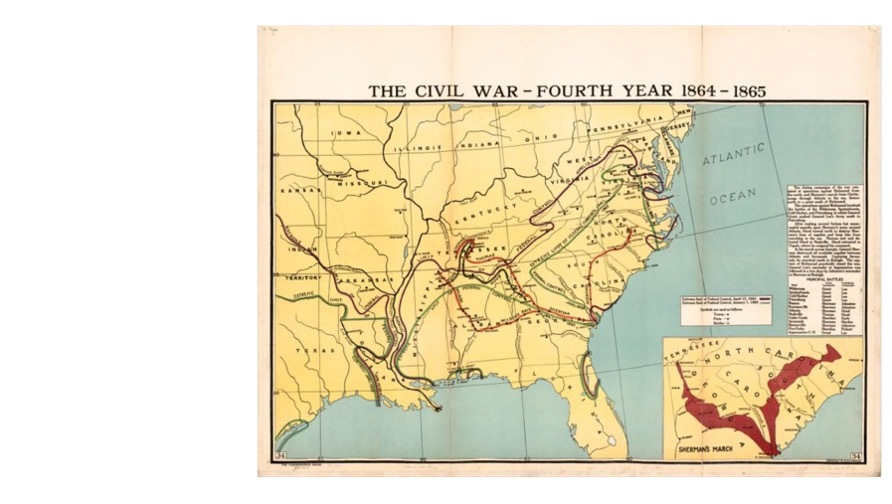
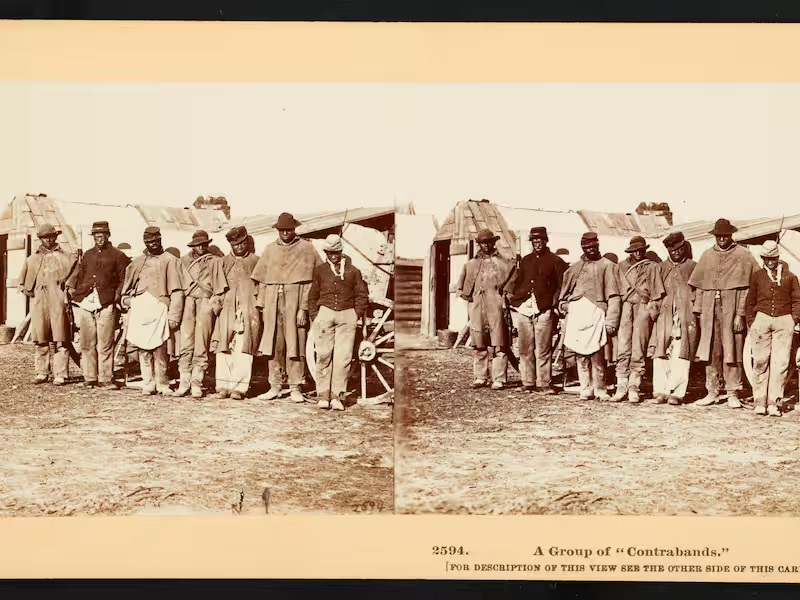
Starting in Atlanta, Georgia, General William Tecumseh Sherman led his Union soldiers through the South, pillaging towns and cities. His goal was to simply disrupt the Confederacy as much as possible, and Sherman did not initially plan on burning houses, stealing property, or rescuing slaves.[1] His reputation and support for the Union gave enslaved workers hope; they called the soldiers Lincoln’s men, and despite illness or age, they joined him and his army. By the time the Union Army had reached Savannah, Georgia, about 17,000 refugees had joined them. With the sudden rise in refugees, or contraband, Sherman had to find a way to quell the crowds; while his official orders were to prevent anyone who could not effectively aid the soldiers from joining. Ultimately, he was unsuccessful because the possibility of freedom was too great to pass up.
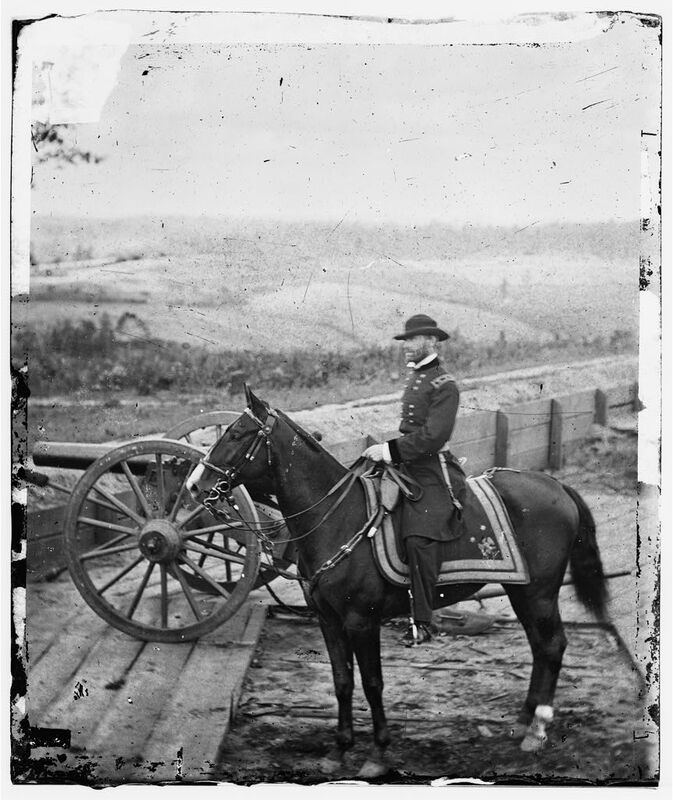
Sherman divided the mounting crowds of refugees between the two companies. Not only would this allow for easier travel, but it would also allow the companies to travel separately. One soldier, Cornelious C. Platter of the 81st Ohio Infantry Volunteers, writes in Rome, Georgia, “All the way from Rome to Kingston the road was lined with 'contrabands' of all ages, sizes and sexes - It was indeed a novel sight to see these people fleeing from Slavery. Every one was loaded - some with bundles of clothes and bedding larger than themselves. We passed through a country which showed plainly the ravages of war.” [2] Platter’s account would not be dissimilar to that of other Union soldiers first encountering refugees. As they continued to travel through Georgia, more refugees joined them in hopes of safety and refuge from their enslavers.
But refugees were not necessarily safe with the Union military. At Ebeneezer Creek in Georgia, several refugees drowned despite their apparent ability to swim. Upon arriving at Ebenezer Creek- 165 feet wide and 10 feet deep- on December 8, 1864, General Jeff C. Davis enlisted his engineers to create a pontoon bridge for his men to cross. When the bridge was completed, he instructed the refugees to stay back while 14,000 of his men crossed the bridge. Once across, General Davis gave the orders to destroy the bridge while the refugees were still on the other side. Knowing the Confederate soldiers were just a few paces behind, hundreds of refugees rushed into the creek attempting to reach the other side. The freezing waters and fast currents dragged several people under. While some of Davis’s men were able to pull some to safety, most drowned.[3]
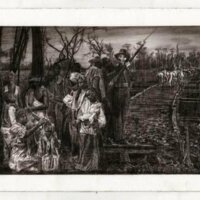
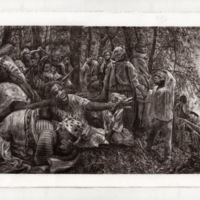
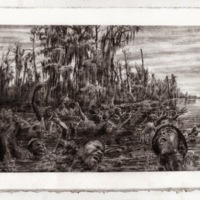
Most refugees were responsible for their own food and would often support the Union soldiers by building makeshift roads called corduroy roads, temporary roads constructed of perpendicular logs over marshy ground, to more easily pass through difficult terrain. Refugees, and some soldiers, also took it upon themselves to begin pillaging local farms and plantations for goods. Some arrived with horses and mules and rode collectively in wagons, while others were forced to walk the journey. Because they often left in a rush and had to travel light, many refugees were not able to bring items with them. The things they did bring offered practical uses, i.e. basic cookware, clothing and bedding. While on the road, they would grab useful items from houses that they pillaged along with livestock and other perishable goods to supply them while travelling.
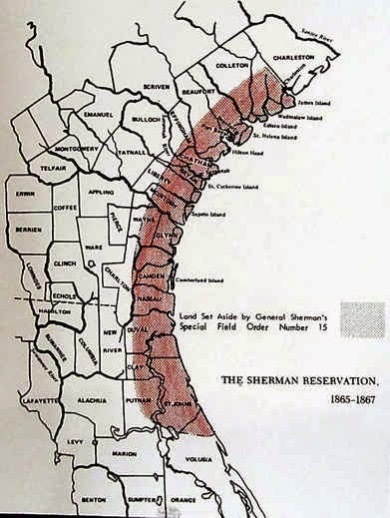
Once in Savannah, Sherman was ready to rid his units of the large number of refugees, about 17,000, by the time they arrived in Savannah.[4] After the tragedy at Ebenezer Creek, public outrage led Secretary of War Edwin Stanton to organize a meeting between him, General Sherman, and twenty African American religious leaders on January 12, 1865.[5] At the meeting, Sherman established a large plot of land from Charleston, South Carolina, to Jacksonville, Florida, as a dedicated space for refugees with Special Field Order #15.[6] For about 20,000 refugees, each would receive a 40-acre plot to live on and cultivate, creating the “forty acres and a mule” saying. There, they advocated for independence and segregation, fearing retaliation. As a result, about half of the refugees were relocated to the Sea Islands, as only 400,000 acres were allotted in the next six months, where they could establish independent communities.[7] Not only did this also establish what is now known as the Gullah-Geechee corridor, but it created a secluded community that allowed for freed men and women the ability to create and grow independent communities.[8] Unfortunately, after President Lincoln’s assassination, President Andrew Johnson overturned this order and returned confiscated lands. Though this lasted for less than a year, the attempt to create a dedicated space for refugees was not abandoned.
As Sherman and his men continued north through South Carolina and North Carolina, refugees continued to join them, but this time, it was more than just freed slaves. White Southern dissenters also began to join as their homes and towns were being destroyed, or to escape persecution from Southern Confederates. As it reached Columbia, South Carolina, about 25,000 refugees and 2,500 wagons and ambulances accompanied Sherman's army. Soldiers report “trains of refugees loaded in all sorts of vehicles and out-landish crafts; family coaches full of ladies of polite society, rheumatic old carriages and army wagons, contain poor whites, men, women, and children, country carts, farm wagons and nondescript riggings black with old aunties, gray negroes, and little pickaninnies,” and a record of about 4,000 white refugees joined Sherman after his triumph through Columbia.[9]
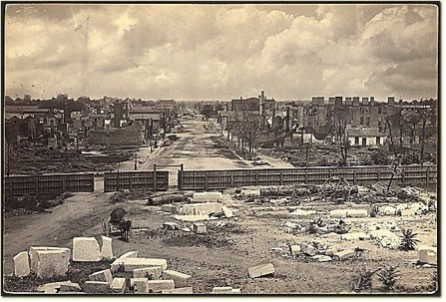
Sherman and his army arrived in Fayetteville, North Carolina, on March 11, 1865, with approximately 25,000 refugees, and by this time, rations and patience had started to wear thin. Sherman, determined to continue his way north to Goldsboro, North Carolina, decided to would be best to send the refugees to Wilmington. The next day, Sherman sent a letter to General Grant stating, “I could leave here tomorrow but want to clear my columns of the vast crowd of refugees and negroes that encumber us. Some I will send down the river by boats and the rest to Wilmington by land, under small escort as soon as we are across the Cape Fear River.”[10] Platter reports crossing the Cape Fear River into Fayetteville on March 13 and 14 stating that “All the refugees and contrabands were left at the River (sic) they will be sent to Wilmington Our Div [Division] has at least 1000 contrabands and it was not an unusual sight to see from 20 to 30 in a wagon - It will be quite a relief to get clear of them.”[11]
Major John S. Windsor was charged with the responsibility of escorting the refugees to Wilmington. While most refugees walked- reportedly 25,000 according to Sherman- he had previously mentioned sending them by boat. Several Confederate boats were captured by the North and repurposed to haul refugees and goods to northern ports. A letter to Governor Zebulon Vance, mentions a shipwreck in Cape Fear River around the middle of March resulting in the death of about 400 refugees. Though, this shipwreck has not been verified through historical records and archaeological remains, the mortality of this trip was a harsh reality for refugees, and attempting it, likely meant death.[12]
Windsor was to take the refugees south to Clinton, North Carolina, and then continue to Wilmington. Union soldier Thomas Osborn watched as “7,000 negroes, and several hundred [white] refugees” prepped for their journey. White refugee Josephine Bryan Worth observed the freedmen as “(sic) invariable gay hearted” and the white refugees as “sad and hopeless.”[13] While the white refugees had lost their homes, the freedmen were looking forward to freedom.
What they did not know was whether or not Wilmington would welcome them.