Life at Fort Anderson
The first few weeks after arriving at Fort Anderson were awful. Thousands of refugees arrived sick and injured. Combined with poor sanitation, yellow fever and smallpox began spreading rapidly, killing several hundred within the first month, “an average of about 30 a day…”.[32]There was no hospital accommodation of any account furnished at this camp. And within two months, the Charleston Daily News reported 2,000 deaths.[33] Nat Jones, a refugee at Fort Anderson, reported deplorable living conditions, with inadequate bedding. These conditions persisted, partially due to overcrowding but were mainly caused by neglect. It got to the point that while on their deathbed, parents requested their children be “cared for by previous owners…” resulting in orphaned children being sent back.[34]
During this time, refugees still relied on rations from the government. Within Fort Anderson, almost 3,000 rations in the first weeks of April dropped to 1,757 rations by the end of May.[35] Rations included “10 oz. Pork or Bacon, or 1 lb. Fresh or Salt Beef. 1 lb. Corn Meal, five times a week. 1 lb. Flour or Soft Bread, or 12 oz. Hard Bread, twice a week. 10 lbs. Beans, Peas, or Hominy, 8 lbs. Sugar, 2 qts. Vinegar, 8 oz. Candles, 2 lbs. Soap, 2 lbs. Salt, 15 lbs. Potatoes, when practicable, to every 100 rations. And for women and children, 10 lbs. Coffee (Rye), or 15 oz. Tea, to every 100 rations”.[36]
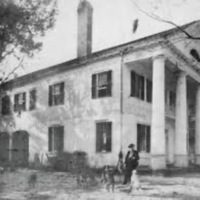
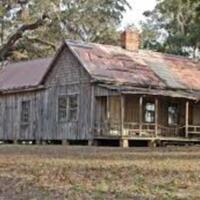
Other than death, another reason for the massive drop in refugees at Fort Anderson is that many voluntarily went back to their previous plantations under new conditions. On April 27, 1865, General Schofield issued Order No. 32, recommending that all refugees return to plantations as long as they were treated kindly and received appropriate wages.[37] This resulted in about half of the remanding refugees leaving by late April 1865.[38] Despite the draw of familiarity and family, many still chose to live at or near Fort Anderson. The surrounding lands were much more appealing for refugees than trying to develop their own housing; Lilliput Plantation alone had about fifteen buildings allotted for twenty-seven enslaved workers.[39] With most of the properties abandoned, refugees could use the enslaved workers' housing and use established fields to harvest crops. One of the only remaining buildings occupied by refugees is the Elijah House on Orton Plantation. Refugees who stayed used these properties to create new lives; they would harvest crops, lumber, and hunt surrounding plantations for home goods, livestock, and other necessary items. By early September, about 87 individuals were given rations on The Oaks, Orton, Lilliput, and Kedal plantations.[40]
Like other camps, refugees initially received rations as a charity from the government; however, after the conclusion of the Civil War, the government could not afford to give rations excessively. As a way to deter refugees from relying on government assistance, many camps would limit the number of rations or try to implement ways to inspire independence. At Fort Anderson, in November 1865, an Order from the Freedman’s Bureau was published in the Wilmington Herald, stating that all freedmen were to find a job or risk their ability to claim rations.[41] But, due to their location and the difficulty of traveling to Wilmington at the time, many refugees found jobs in the lumber and pine tar industries in Brunswick County. Salvaging was another major pastime and a source of income for refugees. They would scour the woods for pieces of metal, then sell them to the foundries for melting. Unfortunately, some refugees lost their lives in work accidents. While some suffered injuries from falling trees or exploding tar pits, the most impactful accident happened on March 9, 1866; Thomas Coates, a freed colored seaman, and Stephen Bruce were in a bunker at Fort Anderson. While exploring the grounds, they lit a match and a candle, resulting in a fatal magazine explosion.[42]
Refugees also began developing connections with and forming bonds between other refugees and white residents. While Colonel Kenneth M. Murchison was staying on the Orton Property as a landlord, Jefferey Lawrence, a freed Charleston house servant, became friendly with Col. Murchison and his children.[43] Not only would these relationships prove to be fruitful in the future, but they also created an incorporated community in an otherwise hostile area.
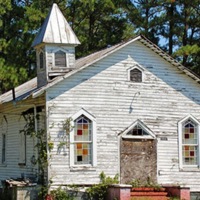
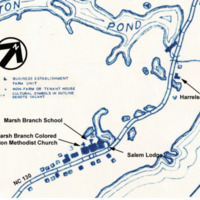
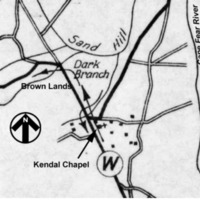
After the end of the Civil War, those who had left their homes started to come back. Those like Dr. Hill found these refugees and had a few options on how to navigate the coming months and new conditions. While some, like Sarah Cooper, negotiated land deals and facilitated refugee homes, churches, and schools, newspaper reports claim that by September 29, 1865, Dr. John Hampton Hill came back to Wilmington and reclaimed his property, forcing refugees off his land.[44] This, however, did not stop refugees from forming independent communities; some of the most notable in the Brunswick County Region are Dark Branch, Marsh Branch, Piney Grove, and Spring Hill.