Refugees in Wilmington
Trips through North Carolina were tough. In conjunction with dangerous animals and terrain, disease and starvation were not uncommon on the path to Wilmington. This came from the inadequate supply of food, dry clothes and shoes, and comfortable places for refugees to sleep. These conditions, combined with previous ailments and age, often resulted in deaths along the trail. But that did not stop anyone from trying to reach freedom.
Sherman reports about 25,000 refugees departing from Fayetteville, either on boats or on foot. Tracking their movements through either transportation method is hard because of the lack of record keeping; so, trying to determine how many made each trip is almost impossible to determine. Most likely, many of the refugees who did travel south by boat were white refugees, rather than freed enslaved workers. There is mention of a vessel travelling through and crashing in the Cape Fear River with approximately 400 refugees aboard, but based on the time period, this letter most likely refers to the General Lyon.[24]
But, though through no fault of the refugees, only about 6-7,000 refugees made it to Wilmington on foot. Whether some stopped and settled in areas along the way, which is plausible given the existence of locations like Liberty Hill and other unincorporated communities in Brunswick County, or unfortunately did not make it, the refugees that did arrive in Wilmington were far from safe.
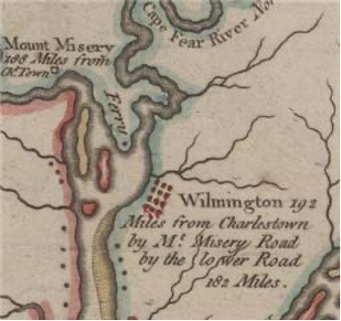
Refugees arrived in Wilmington starting as early as March 22, 1865, by way of Point Peter, a land mass at the convergence of the Cape Fear River just north of Wilmington. After arriving at Wilmington, some refugees were granted shelter in houses and hospitals. By March 23, Major General Joseph R. Hawley sent a letter to Major General Quincey A. Gilmore, asking to relocate about 300 refugees to Charleston, indicating the rising population was immediately and issue for Wilmington.[25] But for those who stayed, they were placed in vacant houses and other hospitals before their final relocation. One Wilmington resident, Catherine Douglass de Rosset Meares, wrote to her mother, March 28, 1865, stating that several abandoned houses had been repurposed into hospitals and filled with refugees.[26] Soon, Wilmington was overrun.
With the sudden influx of both refugees and wounded soldiers, Wilmington was unable to successfully sustain these people. To combat the rising population and to clear space for more seriously wounded soldiers, hundreds of the wounded were sent to the surrounding cities, including Goldsboro, Wilson, and Fayetteville, while refugees were relocated south, specifically in Brunswick County.[27] But before, Major General Joseph R. Hawley began organizing refugees in Wilmington to clean wharves, hospitals, and streets for adequate housing and food, as a way to combat sanitation issues, and provide guidelines for refugees.[28]